Keep one card, pass the rest. Drafting turns a pile of cards into a string of small decisions, and it has outlasted its experimental beginnings. Here is how it works and what designers can borrow.
Few card game mechanics fit into a single sentence as neatly as drafting: you look at some cards, take one, and hand the rest on. That small loop has shaped trading card game events and tabletop games alike, and it is worth understanding if you are designing your own set.
How the loop works
Board game writers usually split drafting into two families. In open drafting, a shared display of cards sits on the table and players take turns choosing from it. In closed drafting, also called pick-and-pass, each player holds a hand, keeps a card or more, and passes the rest to a neighbour. Then everyone looks at the new hand they were handed and does it again.
In 7 Wonders, a well-known example, every player picks a card from their hand at the same time. Once everyone has chosen, each player passes the remaining hand to a neighbour and the next turn begins. A review at Meeple Mountain notes that this simultaneous style was still a somewhat novel idea when the game came out, and that the game helped popularise the mechanic. The same review argues that the choices stay quick because there are few enough paths forward, yet each one feels like it matters even though luck decides which cards you see and when.
Where it came from
The trading card game version has a more tangled history. According to a history of Limited play from Three for One Trading, drafting teams from a shared pool was part of the appeal of stat-based sports games such as Strat-o-matic Baseball, and Richard Garfield took inspiration from that game while designing Magic: The Gathering. In his Pocket Players' Guide he described two early drafting styles, one where players pick from cards laid out in front of them and one resembling what we now call Rochester draft.
Garfield saw two key skills in the game: deck construction and piloting. The same history says drafting was a way to reduce the advantage that deck construction alone could give a player. Everyone builds from what they are handed, so the person with the biggest collection no longer wins the building contest by default.
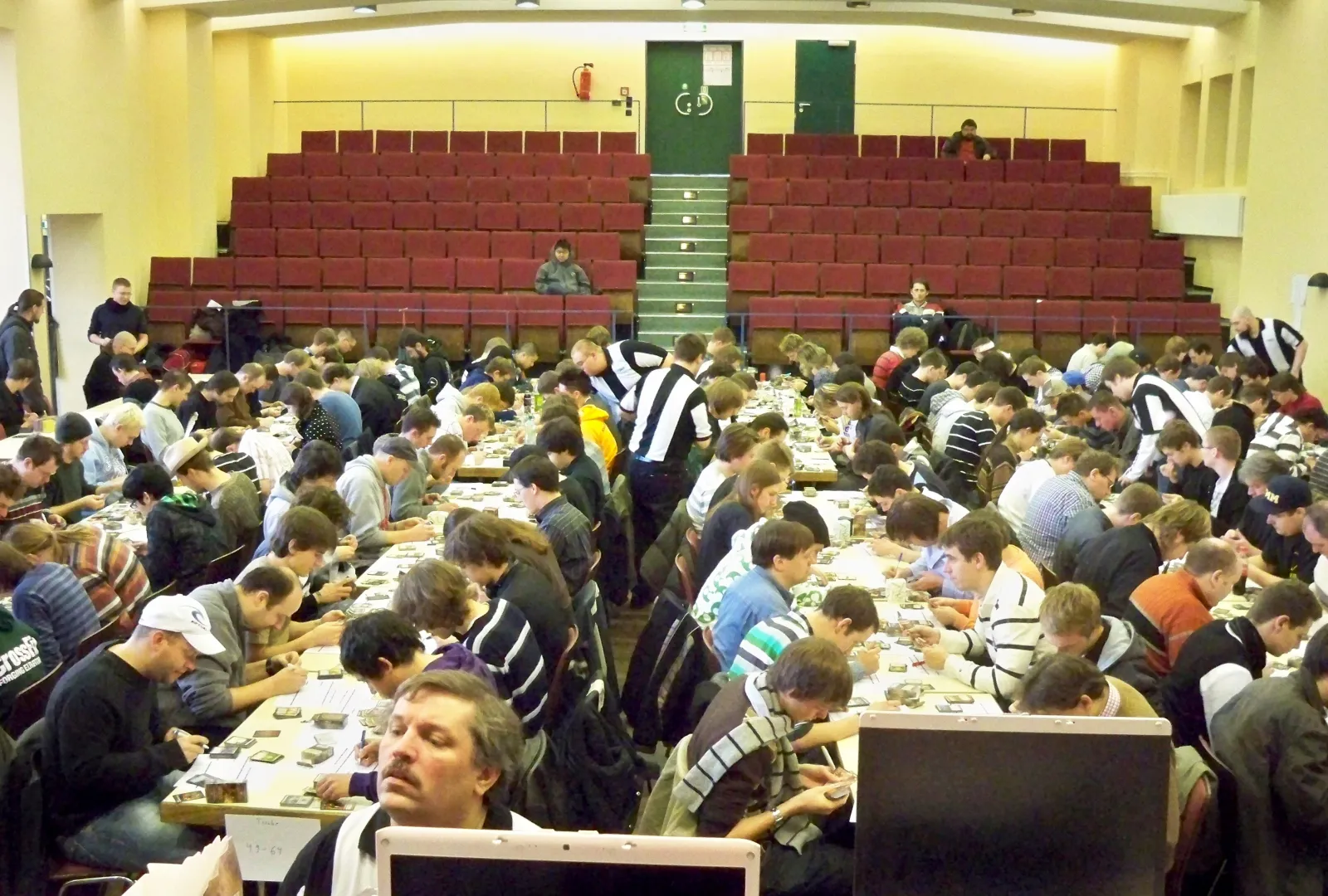
The format was not an instant hit. The same article quotes Mark Rosewater as saying that early players found Limited too random. Early Grand Prix events alternated between Constructed and Limited formats. Rochester draft debuted at Grand Prix Rochester in New York: players opened packs, picked in turn order, then reversed direction. It was deep, but it was slow and hard for newcomers to follow. Booster draft overtook it because stores valued the shorter time commitment, and newcomers could pick freely without social pressure.
Why it endures
Three things seem to keep drafting alive. First, it makes every pick a commitment. Taking one card means leaving others behind, so the decision has weight without needing a complicated rule to enforce it.
Second, it is flexible. Meeple Mountain's step-ladder article covers light games and heavy ones: Sushi Go! by Phil Walker-Harding, which it says can be taught in under two minutes and played in about 20, sits at one end, while Ginkgopolis by Xavier Georges, an engine-building and area-control game, sits at the other. The same mechanic carries both.
Third, it keeps changing. The Three for One history lists variations over the years, including multiplayer drafts, team drafts, bonus sheets with special cards in every pack, and cube drafting, which combines several of those ideas.
What to take from it
If you are building a set in TCG Studio, drafting is a useful lens even if your players never sit around a table. Ask whether a stranger could open a pack and see two or three plans in it. Ask whether the cards you hand away are ever painful to lose. Meeple Mountain's review also reminds us that luck in what you are shown does not hurt a game as long as the choices that follow still feel meaningful.
Two cautions come straight from the history above. Players called early Limited too random, so give drafters a way to recover from a weak pack. And Rochester draft shows that depth is not enough on its own: if the process is slow or hard to follow, newcomers drift away. Keep the loop short, keep each pick readable, and the mechanic will carry much of the weight for you.
Sources
Changing the World of Limited - Three for One Trading · 7 Wonders Review: A Monumental Design - Meeple Mountain · Board Game Step Ladder: Card Drafting - Meeple Mountain