Your first hundred card ideas will be unbalanced, and that is normal. Here is how designers and published guides suggest you keep a first set focused, testable and fun.
A first card set is exciting and a little daunting. Every idea feels like it belongs, the spreadsheet grows quickly, and then the first playtest shows that one card wins every game. The good news is that this is the normal path. One guide to creating a trading card game puts it bluntly: expect your first hundred card ideas to be unbalanced, and treat refining them as part of the process, not a sign you have failed.
Here are some habits drawn from that guide and from Mark Rosewater's well-known talk on lessons from Magic design.
Lock the foundation before the cards
The guide advises defining your core concept, player fantasy, target player and win condition before you design individual cards. It also asks you to choose a resource system deliberately, contrasting a high-variance land-style system, an automatically increasing mana system, and a hybrid where any card can be spent as a resource. Changing any of these after you have forty cards written means rewriting most of them, so settle them first.
Keep the first set simple
The same guide says a first set does not need many keywords and that complexity can be added in later expansions. A small, readable set is also easier to balance: fewer moving parts means fewer unexpected interactions to chase down.
Give cost a clear meaning
Set a cost-benefit curve and write it down. A higher-cost card should be better than a lower-cost one, and you need to decide how much better. A spreadsheet with name, cost, card type, rules text, stats and rarity lets you compare cards side by side and spot the outliers before a player does.
Weigh card advantage against tempo
The guide describes card advantage as having more resources, such as cards in hand, and tempo as using your resources efficiently to affect the board now. Good games force players to choose between the two. If your set offers only one of them, there is no decision to make.
Test cheap and early
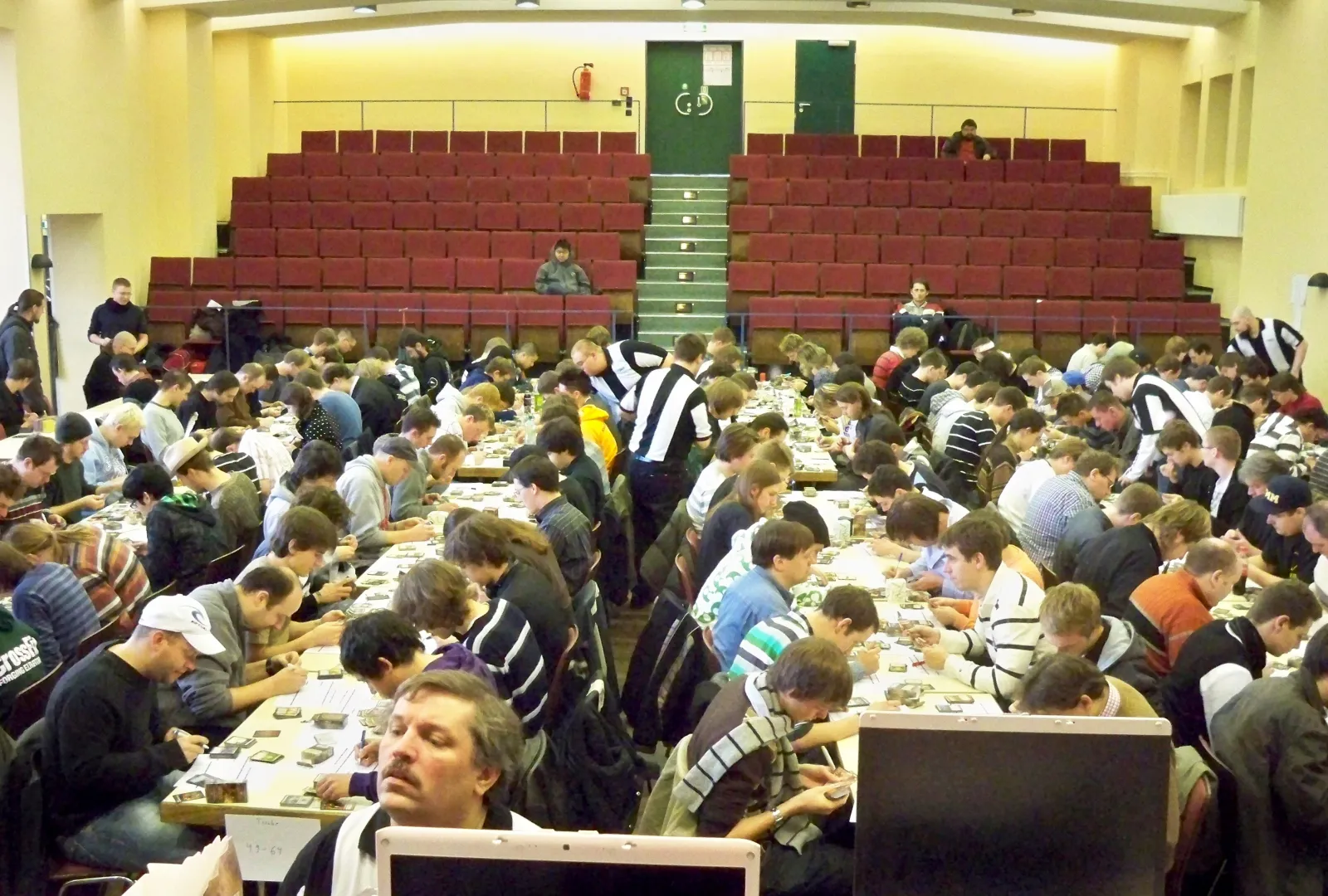
The guide suggests starting with ordinary cards in sleeves, with slips of paper carrying your designs, so you can change a card in seconds. Run blind playtests and watch where players get confused. Only later move to a single printed copy, then a small batch for wider feedback. The same logic applies when you build a set digitally: test the rough version before you polish the art.
Listen to problems, not solutions
Rosewater's talk, summarised in this write-up, notes that players are good at identifying what feels wrong but poor at proposing fixes. Use their reports to find the problem, then design the solution yourself. The talk also says to change your game to match your players, not the other way around, because players will find and exploit dominant strategies.
One playtest story is worth remembering. According to another set of notes on the talk, the Akroan Horse was renamed Akroan Lion during playtesting, and players did not understand the card. Restoring the original name fixed it. Sometimes the balance problem is really a clarity problem.
Make the winning play the fun play
The notes also describe a lesson about incentives: the fun play should be the winning play. They cite a mechanic in Unhinged where the best strategy turned out to be staying silent and passive, which drained the fun from the game. When you test, ask not only who wins but how they win, and whether you would enjoy playing that way ten games in a row.
Build in room to grow
The same notes encourage leaving room for synergies so players can discover interactions for themselves, and they argue that polarising cards are better than universally mild ones because players need to love something about the game. You do not have to balance every card to the same level of blandness. A few distinctive cards that some players adore can be worth more than a set where everything is fine and nothing is memorable.
If you are building in TCG Studio, treat your first published set as the start of a conversation with your players. Ship something small and clear, watch how people actually play it, and let that guide the next round of changes.
Sources
How to create a trading card game (QP Market Network) · Magic: the Gathering: Twenty Years, Twenty Lessons Learned · 'Magic: the Gathering' 20 Years, 20 Lessons Learned by Mark Rosewater (notes)